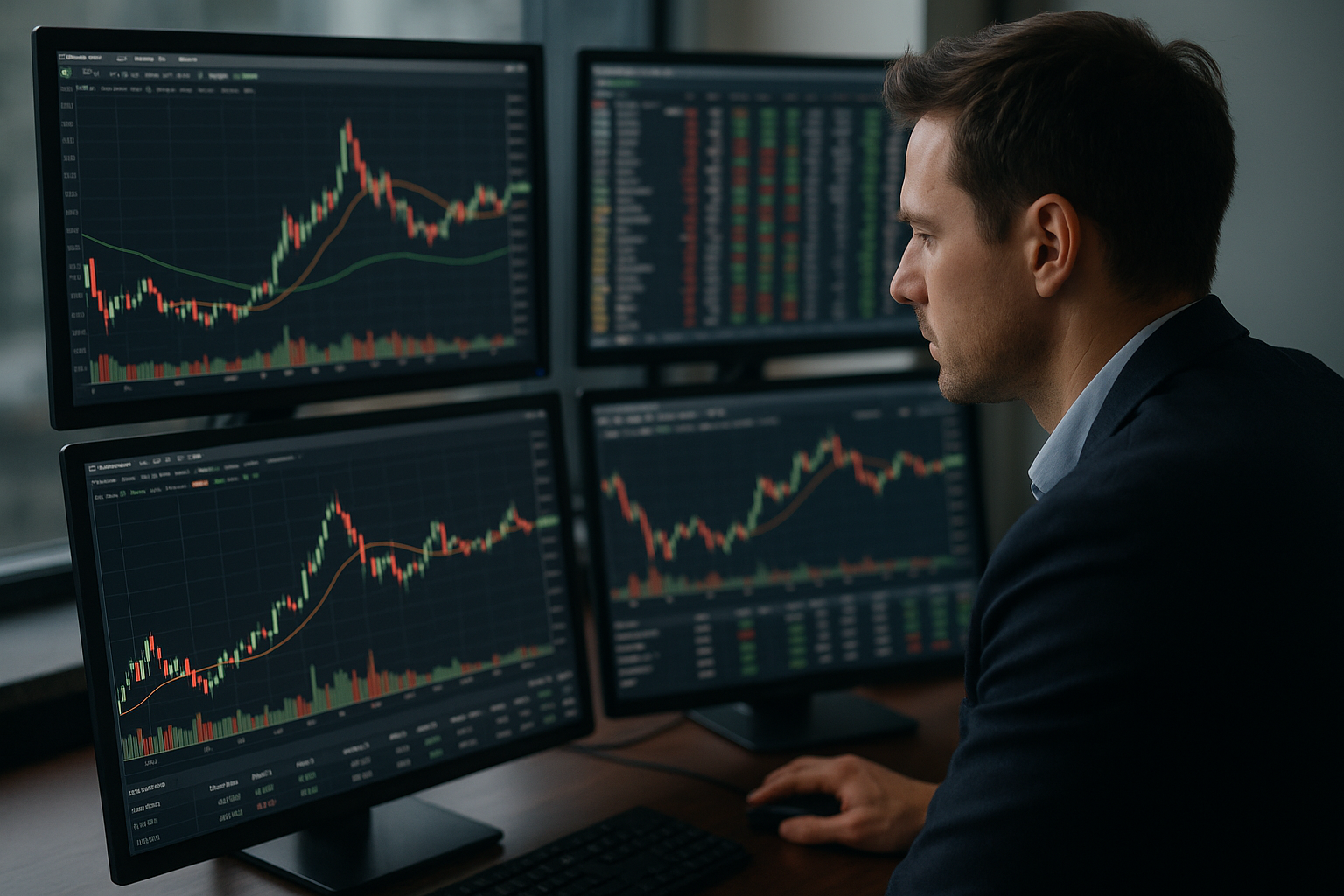
In 2026, trading has fundamentally shifted. The days of manually analyzing spreadsheets and catching market movements hours after they happen are behind us. Model Exorex 100 represents a new generation of investment tools, one where artificial intelligence works alongside you to surface opportunities you might otherwise miss, while you maintain complete control over your capital and decisions.
Whether you're just starting to explore trading or you've been managing investments for years, the complexity of modern markets demands a smarter approach. Model Exorex 100 combines real-time data analysis, transparent performance tracking, and a straightforward setup process to make informed investing genuinely accessible. Let's walk through what this platform actually does, how you get started, and what you can realistically expect.
| Feature | What It Means for You |
|---|---|
| AI-Powered Analysis | Your platform reviews market data continuously, flagging patterns you'd need hours to spot manually. |
| Community-Verified Logs | Every performance claim is cross-checked against real data, so you see a documented track record, not just marketing promises. |
| Simple Setup | Account registration, broker connection, and first strategy configuration typically take under 15 minutes. |
| Demo Account | Test your strategy on real market data with virtual funds before moving any of your own money. |
| Risk Controls Built In | Set your own limits on position size, daily loss thresholds, and trading frequency. You stay in charge. |
| Multi-Asset Coverage | Trade stocks, cryptocurrencies, forex, and commodities from a single unified dashboard. |
What You Need to Remember
Model Exorex 100 is a tool that works for you, not instead of you. It analyzes data faster than you can, flags opportunities you'd otherwise miss, and handles order execution if you want it to. But your capital stays in your own brokerage account, you set all the rules, and you review every decision before it happens.
Automation removes tedium, not risk. Even the best AI-powered platform can't predict market shocks or guarantee returns. What it does offer is clearer information, faster analysis, and the ability to stick to your strategy without emotional second-guessing.
What Is Model Exorex 100 and How Does It Work?
Core Technology: AI-Driven Market Analysis and Signal Generation
At its foundation, Model Exorex 100 is a data processing engine. Every second, it ingests price movements, trading volumes, historical patterns, and publicly available financial indicators across dozens of markets. Instead of showing you raw numbers, it filters out short-term noise and surfaces the patterns that actually matter.
Imagine you're trying to spot a trend in a stock. You'd need to watch the price, check the volume, read earnings reports, scan news headlines, and compare it all to historical behavior. A human analyst might take 30 minutes to do this for a single asset. Model Exorex 100 does it for hundreds of assets in seconds, then presents its findings in language you can act on, not in raw data dumps.
The AI doesn't try to predict certainties or claim it knows what the market will do tomorrow. Instead, it identifies where conditions align with patterns that have historically led to moves you'd want to trade. This distinction matters: the platform is a pattern-recognition tool, not a crystal ball.
How the Platform Connects to Your Broker Account
You maintain complete control of your capital. Model Exorex 100 connects to your broker account through secure API connections. These connections allow the platform to see your account balance, view real-time prices, and execute orders on your behalf if you've set up automated trading. Critically, the API keys you provide do not allow Model Exorex 100 to withdraw your money or transfer funds elsewhere. Your cash stays in your brokerage account at all times.
The workflow is straightforward: you link your broker account, set your risk parameters (how much you're willing to risk per trade, daily loss limits, position size), choose which assets you want to trade, and decide whether you want manual execution (you approve each trade) or automated execution (the platform places trades within your pre-set rules). Each trade happens through your broker, not through Model Exorex 100.
Is Model Exorex 100 Legitimate or a Scam? What You Need to Know
Community-Verified Performance Logs and Transparency Standards
One of Model Exorex 100's core selling points is verifiable results. The platform publishes performance logs for every strategy it offers. Each entry is cross-checked against submitted data and flagged if it doesn't check out. You're not reading marketing claims or cherry-picked testimonials. You're looking at documented trading history.
What does this mean in practice? If a strategy claims to have returned 15% over six months, you can see the entry and exit prices, the dates, the volatility during that period, and the actual drawdowns experienced. You can review strategies that match your risk tolerance and time horizon before you decide to use one yourself. Some users have tracked strategies for 14+ months with full transparency.
This approach builds trust through evidence rather than promises. The platform is essentially saying: "Don't believe us. Check the data yourself." That's a very different posture from most financial marketing.
Key Red Flags and Pitfalls to Avoid Before Investing
No platform is risk-free, and neither is Model Exorex 100. Here's what you should keep in mind before you start trading:
Past performance doesn't predict future results. A strategy that worked for 14 months in one market environment might perform very differently in the next. Model Exorex 100 is transparent about this, but some users still fall into the trap of expecting historical returns to repeat automatically.
Automation requires discipline. Some traders skip the demo account and jump straight to live trading. Others set their strategy running and check in once a month. The platform works best when you treat it like a serious tool, not a set-and-forget system. Review your settings regularly, monitor your positions, and stay engaged.
Deposits matter. While the platform accepts modest starting deposits, traders who start with very small amounts may find that fees eat too much of their returns. Understand your broker's fee structure and make sure your account size makes sense for the markets you want to trade.
Your broker matters too. Model Exorex 100 is a layer on top of your actual brokerage. Your broker's reliability, spreads, execution speed, and fee structure all impact your results. A great strategy on a slow or expensive broker might not outperform a mediocre strategy on a quality broker.
How to Get Started With Model Exorex 100: Step-by-Step Setup Guide
Account Registration and Identity Verification Process
Getting started takes about five minutes. Visit the Model Exorex 100 website and click the sign-up button. You'll be asked for your first name, last name, email address, and phone number. Enter accurate information here, as you'll need it for verification later.
Once you submit your details, a Model Exorex 100 representative will reach out to confirm your phone number and walk you through the next steps. This human touch helps new traders understand what they're getting into. The representative doesn't pressure you to fund an account immediately. They explain how the platform works and answer questions.
Identity verification comes next. You'll provide a government ID and proof of address (a recent utility bill or bank statement). This is standard practice for trading platforms and takes about 48 hours to verify. During this time, you can explore the dashboard and familiarize yourself with the interface.
Funding Your Account and Configuring Your First Strategy
After verification is complete, you're ready to connect your broker account. Model Exorex 100 works with brokers in 28 countries. Look for yours in the supported brokers list. If you don't already have a brokerage account, you'll need to open one first (this is a separate process, unrelated to Model Exorex 100).
To connect your broker, you'll generate API keys from your broker's settings. These keys allow Model Exorex 100 to see your account and place trades. Paste them into Model Exorex 100's settings, and your account is linked. The entire process typically takes 10 minutes.
Next comes funding. Transfer money from your bank account to your brokerage account using your broker's deposit methods. Model Exorex 100 doesn't hold your money, and you don't fund a separate "Model Exorex 100 account." All your capital sits in your brokerage account, which you control entirely. The minimum deposit depends on your broker, but many accept starting amounts of $500 to $5,000.
With money in your brokerage account, you're ready to configure your first strategy. You'll specify which assets you want to trade (stocks, crypto, forex, commodities), your risk tolerance (how much you're willing to lose per trade), your position size, and whether you want manual or automated execution. The platform walks you through each step with clear explanations.
Using the Demo Account to Test Before Live Trading
Before you deploy real money, use the demo account. This is not a toy version of the platform. It uses real market data, real price feeds, and the same AI analysis as the live platform. The only difference is that your trades execute with virtual funds, so you can't lose real money.
Spend at least one week in the demo account if you're new to trading. Watch how your strategy performs. Notice which assets it trades well, which ones are choppy, when it wins and when it loses. This builds familiarity with the platform's behavior and helps you set realistic expectations.
Many experienced traders also use the demo account when testing new strategies or when markets shift into unfamiliar territory. It's a risk-free way to validate your settings before going live.
Model Exorex 100 Features and Tools: What Sets It Apart?
AI-Powered Data Analysis vs. Traditional Stock Picking
Traditional investing often looks like this: you read an article, hear a tip from a friend, spot a story in the news, or notice a stock has been going down and think it's a bargain. You do some research, maybe read a quarterly filing, and make a decision. By the time you've gathered this information, several hours have passed and the opportunity may have shifted.
Model Exorex 100 works differently. It ingests the same information you're reading, analyzes it instantly, and combines it with patterns from historical trading. If you're looking at a stock whose price has dropped 15% but volume is unusually high and several technical indicators are showing reversal signals, the AI flags this as a potential entry point. It does this for hundreds of assets simultaneously.
The advantage isn't that the AI is smarter than you. It's that it's faster and more tireless. You have a job, a family, and limited hours. The AI processes data continuously, 24/7, across global markets. It surfaces opportunities you'd miss simply because you were sleeping or working.
Risk Management Controls and Automated Trading Capabilities
Model Exorex 100 gives you granular control over how much risk you take. You can set daily loss limits, which automatically pause trading if you hit your threshold for the day. You can specify how much of your account you're willing to risk on any single trade. You can cap the maximum position size or the number of simultaneous open positions.
These controls work in both manual and automated modes. In manual mode, you see each trade alert and approve it before it executes. In automated mode, the platform executes trades that meet your pre-set criteria without waiting for your approval. Either way, your risk rules are enforced automatically. The system won't place a trade that violates your settings, no matter how attractive the opportunity looks.
For traders who value discipline, this is invaluable. Automation removes the emotional component. If your strategy says to sell when a stock drops 8%, you won't find yourself holding, hoping it bounces back. The order executes at your pre-set level, and you move on.
Performance Dashboard and Community-Verified Results
Your dashboard shows your account balance, your open positions, your total profit or loss, and your win rate. You can drill down into individual trades to see entry prices, exit prices, and the AI's reasoning for each one. Unlike most trading platforms, Model Exorex 100 explains why it made each suggestion, not just that it made one.
You also have access to the community performance logs. These show strategies other users have deployed and how they performed. This is transparency you won't find on many platforms. You can see that Strategy #2291 returned 8.3% over 14 months, experienced a maximum drawdown of 12%, and had a 64% win rate. This gives you a baseline for comparing different approaches.
Model Exorex 100 Pricing, Fees, and Costs Explained
Minimum Deposit Requirements and Account Types
Model Exorex 100 itself doesn't charge a sign-up fee or a monthly subscription. This is one reason the platform is accessible to new traders. You pay fees through your broker, not to Model Exorex 100.
The minimum deposit depends entirely on your broker. Some brokers accept $500 starting deposits. Others require $5,000 or more. If you don't already have a brokerage account, check a few brokers and compare their minimums and fee structures. This research is worth an hour of your time because it directly impacts your bottom line.
Model Exorex 100 works with different account types: stock trading accounts, cryptocurrency exchange accounts, forex accounts, and commodity trading accounts. You don't need separate accounts for each. Many brokers offer unified platforms where you can trade all asset classes from one account.
Hidden Costs, Broker Fees, and What You Actually Pay
Your actual trading costs come from your broker, not from Model Exorex 100. Here's what to expect:
Commissions: Most brokers charge a small fee per trade, typically $0 to $5 depending on your broker and order type. If you trade frequently, this adds up. Some brokers offer commission-free trading as a loss leader, so shop around.
Spreads: The spread is the difference between the buy price and the sell price. On liquid assets like major stocks and crypto, spreads are tight (usually less than 0.1%). On less liquid assets, spreads can be 1% or more, which significantly impacts your returns. This is where broker quality matters enormously.
Overnight fees: If you hold a position overnight (or longer), your broker may charge interest or a financing cost. This is typically small for stocks but can be substantial for leveraged or derivative positions. Know your broker's policy here.
Withdrawal fees: Moving money out of your brokerage account back to your bank may incur a small fee, usually $0 to $25. Budget for this if you withdraw regularly.
Model Exorex 100 doesn't take a cut of your profits. It's a data analysis and signal generation tool. Your profitability is entirely up to your strategy, market conditions, and how well you execute. This aligns the platform's interests with yours, which is a good sign.
Realistic Expectations: Results, Limitations, and Common Mistakes
Why Automation Is Not a Replacement for Informed Decision-Making
Model Exorex 100 will be most valuable to you if you treat it as a tool that informs your decisions, not a system that replaces your thinking. The AI can analyze data faster than you can, but it can't know your personal risk tolerance, your life circumstances, or your financial goals. Those judgments belong to you.
Some traders make the mistake of setting up a strategy and then disappearing for three months. When they return, they're shocked by losses they didn't see coming. Markets change. Volatility spikes. A strategy that worked in a trending market can underperform in a choppy, sideways market. Your job is to monitor your positions, review your strategy's performance monthly, and adjust settings when necessary.
Think of Model Exorex 100 as a highly skilled analyst who works for you. You wouldn't hire an analyst, tell them to make trades, and then ignore them for months. You'd check in regularly, ask questions, and adjust course as conditions change. Apply the same principle here.
Performance Claims vs. Actual User Results and Documentation
Marketing for trading platforms often emphasizes spectacular returns: "Turn $5,000 into $50,000 in six months" or "92% win rate." These headlines might reflect a cherry-picked strategy or a period of favorable market conditions, not typical results.
Model Exorex 100 publishes actual performance logs, which is refreshing. You can see that some strategies have returned 15% over six months while others have returned 3%. Some show win rates of 72%, others 58%. This range reflects reality. Markets reward different approaches at different times.
When you review performance logs, look at the drawdown column. A strategy that gained 12% but experienced a maximum drawdown of 25% experienced a period where it was down significantly from its peak. Could you have stomach that volatility without panicking and pulling out? That question matters more than the headline return.
Set realistic expectations. In 2026, beating the market is genuinely hard. If a broad stock index is returning 8% annually, a strategy that returns 12% annually is doing very well. Be skeptical of anything claiming 50%+ annual returns unless you understand exactly how it achieves that and what risks it takes to get there.
Conclusion
Model Exorex 100 represents a meaningful shift in how individual investors access market data and execute strategies. By combining AI analysis, transparent performance tracking, and straightforward setup, the platform removes friction from the trading process and brings institutional-quality tools to retail investors.
Getting started is simple: register, verify your identity, connect your broker, fund your account, run the demo, and configure your first strategy. Your risk is limited because your capital stays in your broker account and you control all the settings. The learning curve is manageable because the interface is built for first-time traders.
The most important thing to remember is this: Model Exorex 100 is a tool that works with you, not instead of you. It analyzes data faster than you can and executes trades more consistently than you might manually. But your judgment, your risk tolerance, and your ongoing attention remain essential. Trade with discipline, monitor your positions regularly, and adjust when markets shift.
If you've been hesitant to start trading because the complexity felt overwhelming, Model Exorex 100 lowers that barrier significantly. If you're already trading and finding it time-consuming, the automation and analysis features free up hours of manual work. Either way, the demo account lets you explore without risk, so there's no downside to testing the platform yourself.